Showing posts with label fema. Show all posts

Tuesday, July 8, 2025

We Saw It Coming — But No One Listened”

 “We Saw It Coming — But No One Listened”

By Tina Winterlik aka Zipolita

I remember when this poster first started circulating — URGENT: NOAA RESEARCH WEBSITES GOING DARK. I posted it, shared it, talked about it. We even worked together to create awareness. But it didn’t go viral. It didn’t spark mass concern. And now? We are witnessing exactly what we feared.

This isn’t a surprise. This is a consequence.

Earlier this year, over 1,000 NOAA jobs were slashed, including roles at the National Hurricane Center (NHC). One meteorologist even admitted he didn’t know how he could do his job anymore — the data just wasn’t there. We watched the tools of life-saving science get stripped away, piece by piece.

And now? Children are dead in Texas from sudden, extreme flooding. Little girls. Entire families wiped out. The storm hit hard and fast — and few saw it coming. Why? Because there was no way to track it properly. No planes flying into it. No models. No warnings.

Let me be brutally honest: this is the result of policy.
This is what happens when government slashes budgets and silences science.
When FEMA is treated like a burden instead of a backbone.
When climate data is deemed disposable.

We’ve been here before. Remember Katrina? Remember the outrage, the hand-wringing, the excuses? And yet here we are again. Only this time, we knew what was at stake — and we let it happen anyway.

We’ve been warning people about the data gaps.
About how hurricanes lose their names when they become "tropical storms" over Mexico — even if they keep churning through the Gulf and into the U.S. and Canada.
The storm changes name. The urgency fades. But the danger does not.

While politicians argue over "whose fault," more tragedies are forming over the horizon. And we have no way of seeing them coming, no matter how high the floodwaters rise.

The truth is this: they were warned.
We were all warned.
And we didn't act.

What other disasters are on their way now — silent, invisible — because the research was deleted, the servers unplugged, the experts laid off?

It’s time to say it out loud:
This is not just a climate issue.
This is justice.
This is life and death.
And this is on us.

📌 Let’s make sure the next time we see it coming, we act — before it’s too late.

#SaveTheData #NOAASOS #ClimateJustice #FEMA #TexasFloods #WeatherWarning #HurricaneTracking #WeTriedToWarnYou #DataMatters


Saturday, July 5, 2025

Never Turn Your Back on a Wave

 🌊 Never Turn Your Back on a Wave

By Tina Winterlik aka Zipolita
📍 July 2025


A hurricane just tore through Zipolite and Huatulco. Its name was Erick. It spun up out of nowhere and became a monster in 24 hours — not even time to breathe. Floods, landslides, people cut off, infrastructure washed away.

Then — poof — it’s “downgraded,” no longer a hurricane. The media drops it. But the storm didn’t stop. It carried on — across Mexico, into Texas, where more than 30 people died in catastrophic flash floods around the Guadalupe River. Most people didn’t even know the storms were connected.

Because the system is broken.


🌍 We Are Not Islands

When the storm leaves Mexico, Mexico breathes a sigh of relief: “Thank God it's gone.”
But does the U.S. care? Not really.
And when the leftovers crawl toward Canada? Crickets.

There’s no real cooperation. No shared system that tracks a storm from birth to death. Everyone is busy with their own borders and bureaucracy. The U.S. cuts the EPA, the NOAA gets slashed, the satellites aren't maintained — and everyone wonders why we didn’t see it coming.

But we did.

We just weren’t listening.
We weren’t talking to each other.
And some people don’t want us to — because when we know the truth, we demand better.


💥 The EPA Was Gutted — And It Matters

The Environmental Protection Agency (EPA) once helped track pollution, protect clean water, and warn about ecological collapse. But under past U.S. leadership, it was stripped down, scientists silenced, and climate programs slashed.

What happens when you fire the experts?
When you muzzle the people sounding alarms?
When you say climate change is fake while the skies fall?

You get people swept away in rivers.
You get mudslides burying towns.
You get hurricanes that nobody tracks from one country to the next.
You get a global system acting like a bunch of strangers in the dark.


🌀 “Never Turn Your Back on a Wave”

I have a saying. It comes from the beach — from life:

Never turn your back on a wave.
Because that wave might just splash you,
maybe even smack you on the butt and make you laugh —
but it might just as easily knock your legs out,
slam you into the sand, and break your neck before you even know what happened.

That’s what these storms are like.
They don’t care about politics.
They don’t care about state lines.
They don’t care about your forecast app.

They’ll build in the tropics,
explode over the ocean,
rip through poor communities,
and then travel thousands of kilometers inland to flood your home —
long after the name is gone and the news cycle has moved on.


🧠 What Needs to Change?

  • We need to track storms through their whole lifespan, not just while they’re “official.”
  • We need cross-border coordination between Mexico, the U.S., and Canada.
  • We need to restore the EPA, fund climate science, and respect Indigenous knowledge about weather and land.
  • We need to wake up before the next wave drags us under.

This isn’t just about hurricanes.
It’s about how disconnected we’ve become — from each other, from the Earth, from the truth.

We have to do better.
Because the wave is coming — whether we’re watching or not.


🌀 Stay aware. Stay connected. Never turn your back on a wave.
Tina Winterlik / Zipolita


Sunday, August 30, 2015

What can we learn from Hurricane Katrina?

UPDATE: I just wanted to add this image.


I watched the film below today. It's 4 parts. Shocking, very very disturbing how the events of this disaster unfolded.

How did it go so wrong and could that happen here? I shudder to think!

I send out love and light and pray so hard for all those poor Hurricane Katrina victims. Those poor poor people. Why? Why did they have to suffer like that? 

It is a very sad film but it is very well done and tells the story that I had never heard or known about and I think is very important people hear about it.

 I always wanted to visit New Orleans and I am sad I never saw it before. New Orleans is obviously made up of strong, courageous and determined people and I am sure they will endure, but the challenges faced here are understandably too many for most to survive. 

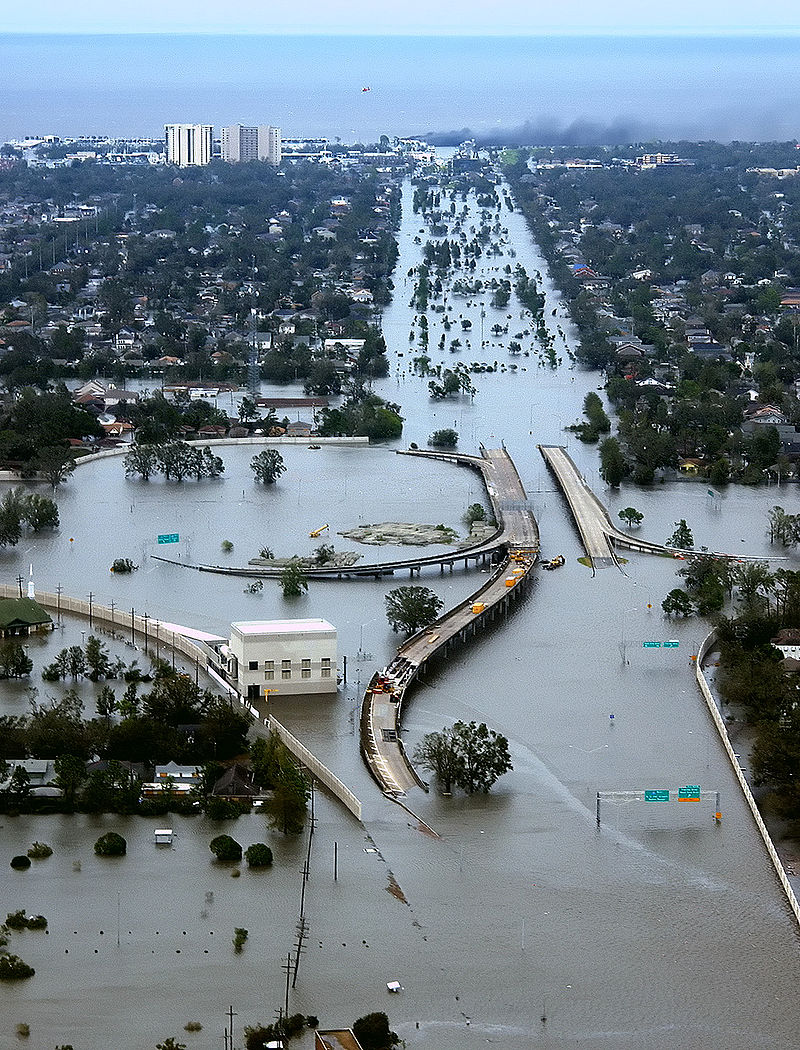
AP Photo/U.S. Coast Guard, Petty Officer 2nd Class Kyle Niemi


They will suffer the effects their entire lives and that will affect everyone around them. I hope a lot of lessons were learned by the government and city planning people especially as communities more people move to no cars and would have no way to evacuate should a disaster happen.

As global warming happens and we are warned of the melting polar ice caps and rising sea levels everyone needs to pay close attention and learn to be prepare in case they are faced with similar scenerios. Frightening indeed, no one wants to think about it but these people lived it. What would you do?


WHEN THE LEVEES BROKE: A REQUIEM IN FOUR ACTS is a Spike Lee Film and a 40 Acres & A Mule Filmworks Production.

Directed and produced by Spike Lee; producer and supervising editor, Sam Pollard; cinematography, Cliff Charles; editors, Geta Gandbhir and Nancy Novack; composer, Terence Blanchard; line producer, Butch Robinson. For HBO: supervising producer, Jacqueline Glover; executive producer, Sheila Nevins.


I do suggest you watch but it is not for children, there should be a warning because it shows graphic images. There are powerful messages in this film. Learn from it and share it. Pray for those affected and help in anyway you can.


Featured on Films for Action
http://www.filmsforaction.org/watch/when-the-levees-broke-a-requiem-in-four-parts-2006/

"The film also looks at a community that has been through hell and back, surviving death, devastation and disease at every turn. Yet, somehow, amidst the ruins, the people of New Orleans are finding new hope and strength as the city rises from the ashes, buoyed by their own resilience and a rich cultural legacy."

 https://en.wikipedia.org/wiki/Hurricane_Katrina
Katrina caused severe destruction along the Gulf coast from central Florida to Texas, much of it due to the storm surge. The most significant number of deaths occurred in New Orleans, Louisiana, which flooded as its levee system failed, in many cases hours after the storm had moved inland.[4] 

Eventually 80% of the city and large tracts of neighboring parishes became flooded, and the floodwaters lingered for weeks.[4] However, the worst property damage occurred in coastal areas, such as Mississippi beachfront towns; over 90 percent of these were flooded. Boats and casino barges rammed buildings, pushing cars and houses inland; water reached 6–12 miles (10–19 km) from the beach. 

Hurricane Katrina also affected Canada-https://en.wikipedia.org/wiki/Hurricane_Katrina
In Canada, the remnants of Katrina brought rainfall amounts in excess of 3.94 in (100 mm) to many locations between the Niagara Peninsula and the Saint Lawrence River valley.[78] Severe local flooding occurred in Quebec, forcing the evacuations of dozens of homes in some communities as rivers began overflowing their banks and sewage systems were becoming overwhelmed by the influx of precipitation. Inundated and washed out roads, including Route 138 along the north shore of the Saint Lawrence River, Route 172 north of Tadoussac, and Route 385 near Forestville left several communities isolated for at least a week.[79]